
FASER Briefings
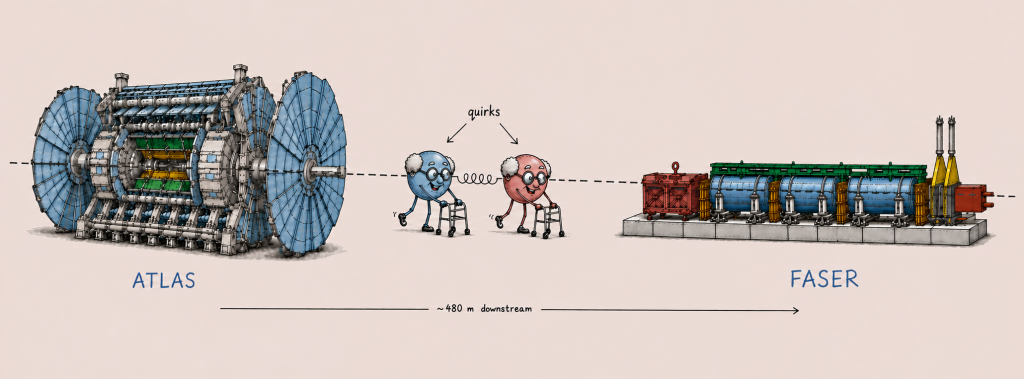
Are New Particles Arriving Late?
Since the discovery of the Higgs boson in 2012 as the missing piece of the Standard Model of particle physics, scientists at CERN have longed to find out what’s beyond. What new search can shine light on open questions, like the nature of dark matter? But what if these searches assume a set of characteristics that are simply wrong? What if, say, quirky new particles are too massive and slow to be detected in traditional ways? What if they come in pairs and move on unconventional trajectories, oscillating around each other?
FASER Briefing | 31 July 2026
A New Way to See Electron Neutrinos at the LHC
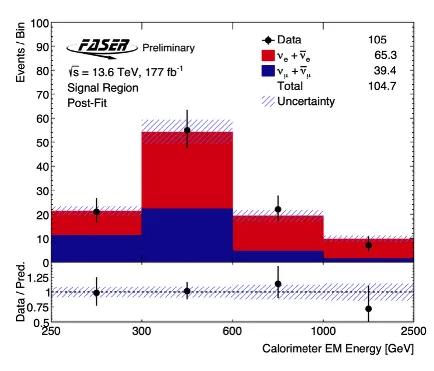
Neutrinos are tiny, almost massless particles that rarely interact with matter. Because of this, neutrinos usually pass through most detectors without leaving any trace. FASER is one of only two detectors at the LHC with the ability to detect neutrinos. FASER physicists have been able to measure these neutrinos based on their energy, observing 65 electron neutrinos using the calorimeter — a FASER sub-detector that captures a particle’s energy. These exciting results demonstrate yet another way that FASER can measure electron neutrinos at the unique high energies produced by the LHC.
FASER Briefing | 26 March 2026
More Muon Neutrinos with FASER’s Electronic Detector
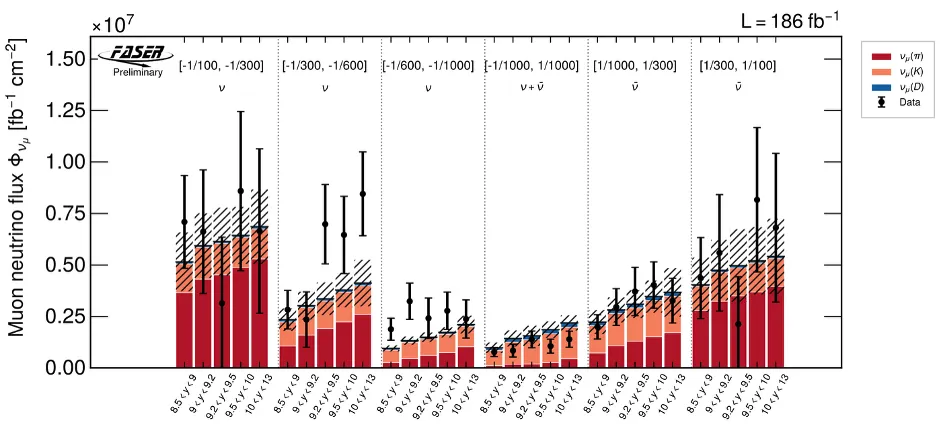
The FASER experiment has performed a new analysis of muon neutrino interactions using proton collisions at the LHC. Using nearly 3 times more data than the previous analysis, new measurements have been made of neutrino energy and rapidity at the LHC. This work will inform future theoretical modelling of the neutrino fluxes and cross sections.
FASER Briefing | 26 March 2026
Photographing TeV Neutrinos with FASER
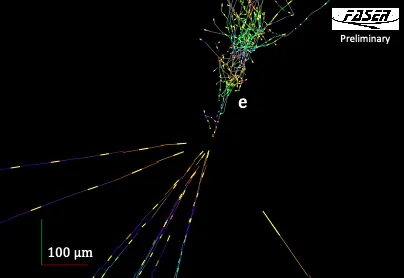
FASER physicists are measuring neutrino interaction cross sections in a previously unexplored energy range, extending beyond current artificial sources and approaching the energy scales of cosmic sources. Using the FASERν emulsion detector, the team investigated seven electron neutrino and thirty-three muon neutrino interactions observed during the 2022 LHC run. The electron neutrino cross section measurement updates and improves the 2023 results, and, for the first time for FASERν, the energy of muon neutrinos is reconstructed, allowing for the energy-dependent cross section to be measured.FASER Briefing | 25 March 2026
Searching for Neutrino-Induced Charm Hadrons at the Energy Frontier
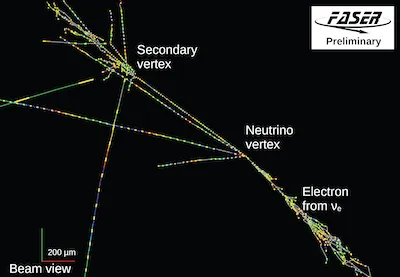
FASER scientists have conducted the first-ever search for charm particles produced by high-energy neutrinos coming from collisions at the Large Hadron Collider. Using the emulsion-based FASERv sub-detector, the team analyzed 40 neutrino interactions recorded during the 2022 LHC run. This pioneering search demonstrates new techniques for spotting the signatures of short-lived charm particles and opens a new window into studying the hadronic system of neutrino interactions at energies never before explored.
FASER Briefing | 24 March 2026
New Dark Photon Results from the FASER Experiment
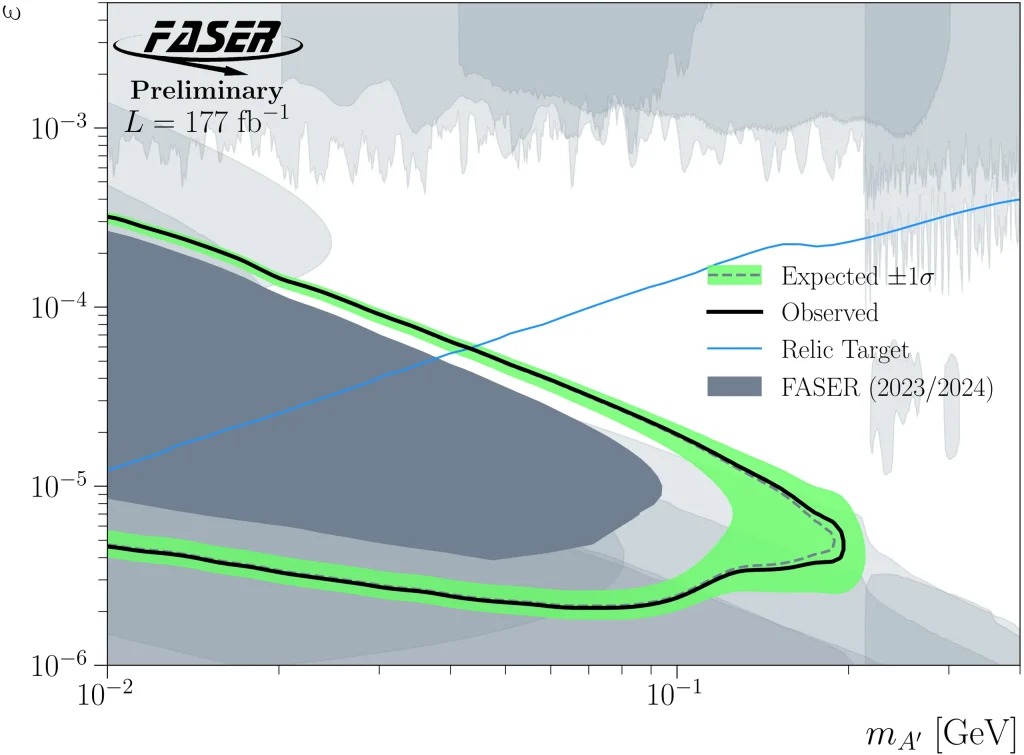
FASER physicists are searching for hints of a “dark sector,” a class of new particles and forces that interact very weakly with ordinary matter. These dark sector particles may be produced in high-energy collisions at the LHC. In their latest result, scientists have set new limits on one such particle, known as the dark photon, by looking for high-energy signatures in the FASER detector.
FASER Briefing | 23 March 2026
September 22, 2026