
Photographing TeV Neutrinos with FASER
New muon and electron neutrino cross section measurement at the TeV scale with FASER’s Emulsion Detector at the LHC
25 March 2026 | FASER Collaboration
FASER physicists are measuring neutrino interaction cross sections in a previously unexplored energy range, extending beyond current accelerator-based sources and approaching the energy scales of cosmic sources. Using the FASERν emulsion detector, the team analysed seven electron neutrino and thirty-three muon neutrino interactions observed during the 2022 LHC run. The electron neutrino cross section measurement updates and improves the 2023 results, and for the first time for FASERν the energy of muon neutrinos is reconstructed, allowing for the energy dependent cross section to be measured.
Despite a nearly 100-year history, postulated in 1930 and discovered in 1956, neutrinos remain one of the most elusive fundamental particles. There are three known types, or “flavours”, electron, muon and tau neutrinos, all of which have a very small mass (so small that they have not yet been measured precisely) and interact very rarely with matter, giving them the nickname of “ghost particles”. Although studying them requires significant experimental effort, physicists have developed a large array of experiments to detect neutrinos produced by a large variety of sources, from accelerators and nuclear reactors (artificial) to the Sun and cosmic rays (natural). Until recently, however, one important source was missing: neutrinos produced at particle colliders.
When studying neutrinos, an important property of their interactions is the cross section; this represents the probability of a neutrino interacting with matter. Using accelerator-based experiments, this value has been measured up to a few hundred GeV, and in the case of muon neutrinos originating from cosmic rays, the cross section has been measured above 6 TeV. This leaves the multi–TeV region unexplored, yet it is accessible at colliders such as the CERN Large Hadron Collider.
The LHC collides particles at the highest man-made energies, with building-sized detectors surrounding the interaction points measuring the resulting particles. However, many particles are produced in the very forward direction, traveling along the collision axis and escaping detection by these large experiments. Many of the particles subsequently decay into neutrinos, effectively producing the highest energy man-made neutrino beam.
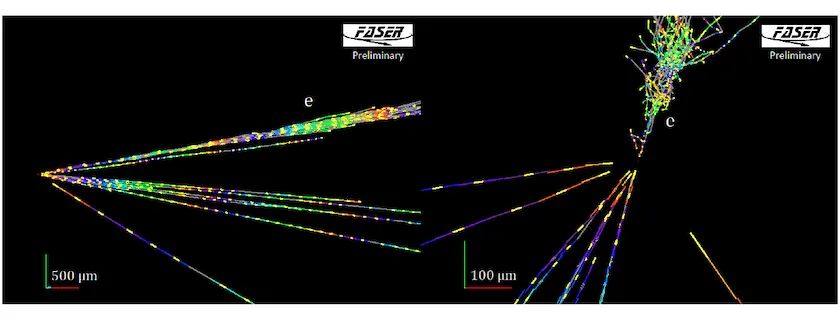
The ForwArd Search ExpeRiment (FASER) is specifically designed to detect these neutrinos, probing an energy range never explored before. Its sub-detector, FASERν, consists of alternating layers of tungsten plates and nuclear emulsion films. As an ultra-precise photographic detector, FASERν is capable of recording the tracks of charged particles produced in neutrino interactions with sub-micrometer resolution. In particular, the detector can identify the charged lepton produced in the interaction, allowing the event to be reconstructed. With its exceptional spatial resolution and dedicated analysis tools, both the topology and kinematics of the events can be studied in great detail. An example is shown in the event displays above, in which an electron neutrino interaction is shown in both the beam view (left, from the point of view of the incident neutrino) and in a rotated view (right) – the electromagnetic shower from the daughter electron is clearly visible.
In 2023, FASER measured the electron and muon cross sections using the FASERν emulsion detector without reconstructing the neutrino energy, performed on a subset of the neutrino interactions recorded during the 2022 LHC run.
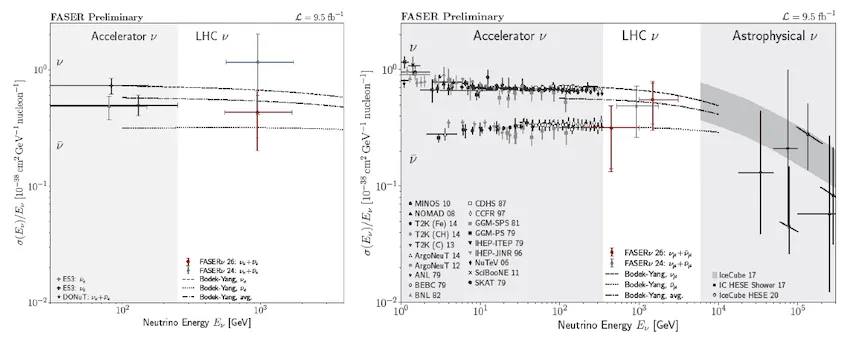
Since then, a larger number of neutrino interactions have been reconstructed and investigated, with seven electron neutrino candidates and thirty-three muon neutrino candidates identified in 9.5 fb-1 of data. This allowed the team to repeat and improve the electron neutrino cross section measurement, shown in the left-hand plot of the figure below.
In 2023, FASER measured the electron and muon cross sections using the FASERν emulsion detector, based on a subset of neutrino interactions recorded during the 2022 LHC run. In that analysis, the neutrino energy was not yet reconstructed.
Since then, a larger dataset has been analysed, leading to an increased number of reconstructed neutrino interactions with seven electron neutrino candidates and thirty-three muon neutrino candidates identified in 9.5 fb-1 of data. This allowed the team to repeat and improve the electron neutrino cross section measurement, shown in the left-hand plot of the figure below.
For muon neutrinos, a neutrino energy reconstruction method has been developed using machine learning techniques, tailored to the constraints of emulsion detectors and forward neutrino interactions. Thanks to the detector’s unparalleled position resolution,, the momentum and angle of the daughter muon, as well as of the other charged particles in the interaction, could be measured and used as input information to the machine learning methods to reconstruct the incident neutrino energy. The highest energy muon neutrino was reconstructed at 2.95 TeV, the highest-energy human-made neutrino ever measured! By reconstructing the energy event by event, the cross section as a function of neutrino energy was determined, shown in the right-hand plot in the figure below. This method is currently being extended to also reconstruct electron neutrino energies.
Measuring the neutrino energy is essential, not only for determining interaction cross sections, but also for comparing with predicted neutrino fluxes and testing theoretical models of hadron production in high-energy collisions such as those at the Large Hadron Collider. It also enables detailed studies of neutrino interactions as a function of energy, opening the door to a wide range of physics investigations.
As more data are collected, and analysis tools and techniques continue to develop, FASER provides an exciting novel way to look at neutrinos in a previously unexplored energy region, allowing scientists to probe both the fundamental properties of neutrinos and their role in our broader understanding of the Universe.
Learn More
- These results were announced at the 2026 Moriond Electroweak and QCD Conferences: see https://indico.in2p3.fr/event/39055/contributions/170310 and https://indico.cern.ch/event/1648766/contributions/6963969.
- For more details, see the conference note: https://cds.cern.ch/record/2956166.
- For the previous FASERv cross section result, see Phys. Rev. Lett 133, 021802 .
July 25, 2026