
Are New Particles Arriving Late?
First Search for Quirks at the LHC with FASER
31 July 2026 | FASER Collaboration
The Standard Model (SM) of particle physics has been remarkably successful in describing the building blocks of our universe and their interactions. Yet, it clearly doesn’t have all the answers. For instance, there are many cosmological measurements hinting at the presence of something beyond, called dark matter. There is no SM particle that has the right properties to be dark matter.
Scientists at CERN study particle collisions at the Large Hadron Collider (LHC) by building detectors that search for new particles or measure the properties of particle interactions with the utmost precision. The SM has been quite successful in describing these measurements, leaving very little room for hints of something beyond, which we know exists. But where is it? It could be a particle too massive to be produced in the LHC’s collisions. It could be a particle that interacts very weakly with SM particles, meaning that it’s hard to produce from collisions of SM particles and hard to detect using detectors, which are naturally made of SM particles.
But there is another possibility: what if the LHC is already producing these mysterious particles, but traditional LHC experiments are designed with a set of properties in mind for these particles that are simply wrong? What if they can fly for hundreds of meters after production? What if they don’t follow the trajectory of a single charged particle in a magnetic field? In fact, there are hypothetical particles, called quirks, which are theoretically motivated but have experimental signatures overlooked by current reconstruction algorithms of LHC experiments. Until now!

The ForwArd Search ExpeRiment (FASER) shown above is a perfect environment to look for long-lived particles that are produced at the ATLAS interaction point and propagate for 480 meters towards FASER, a journey that barely any SM particle apart from neutrinos and some muons can make. Quirks will be produced in pairs at the interaction point and stay bounded by a new force, called the “infracolor” force, similar to the strong force in the SM, making them orbit around each other. Because of their oscillation and high mass, quirks can be much slower than the background muons and leave twice as much energy in FASER scintillators, as they come in pairs, each with an electric charge of one.
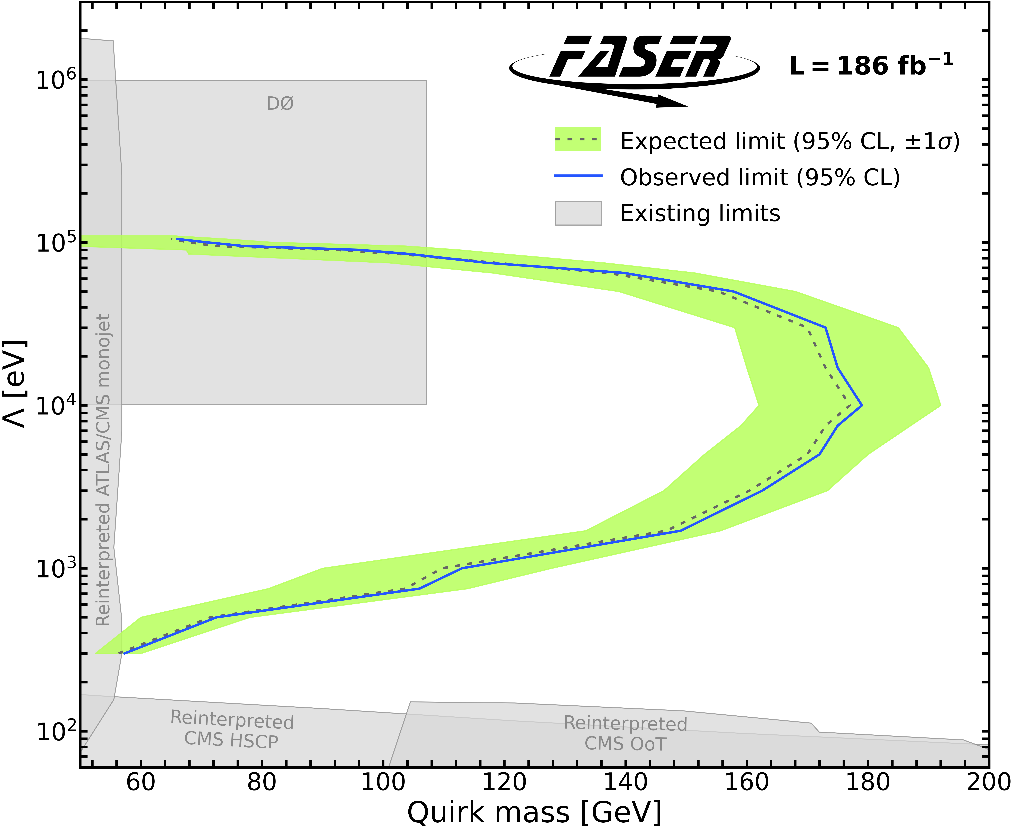
This search uses the dataset collected at FASER between 2022 and 2024 with an integrated luminosity of 186/fb, roughly half of the available data from Run 3 of the LHC. Using the timing and charge information from FASER’s eight scintillating layers, one can identify quirks by their higher charge deposition, slow speed within the detector, and delayed/out-of-time arrival time. No quirk-like event was observed in this nearly background-free search, resulting in the first exclusion of quirks with masses above the weak scale for infracolor confinement scales in the broad range of 300 eV to 100 keV. This is the first direct search for quirks by an LHC experiment, and FASER scientists hope it will set a precedent for other LHC experiments to join the effort to look for this highly-motivated signature!
Learn More
- Preliminary results shown by Arash Jofrehei at LLP2026, June-July 2026, Cambridge, UK
- Final results shown by Eli Welch at ICHEP 2026, July-August 2026, Natal, Brazil
- Preprint, submitted to PRL: https://arxiv.org/pdf/2607.26195
- The FASER Detector, arxiv:2207.11427
July 31, 2026