
Searching for Neutrino-Induced Charm Hadrons at the Energy Frontier
First Search for Neutrino-Induced Charm Hadrons with FASER’s Emulsion Detector at the LHC
24 March 2026 | FASER Collaboration
FASER scientists have conducted the first-ever search for charm particles produced by high-energy neutrinos coming from collisions at the Large Hadron Collider (LHC). Using the emulsion-based FASERν sub-detector, the team analyzed 40 neutrino interactions recorded during the 2022 LHC run. This pioneering search demonstrates new techniques for spotting the signatures of short-lived charm particles and opens a new window into studying the hadronic system of neutrino interactions at energies never before explored.
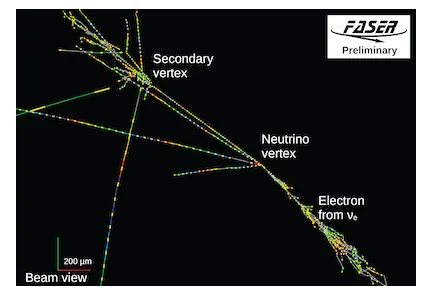
When a neutrino, one of nature’s most elusive particles, interacts with matter, it scatters off the quarks inside protons and neutrons, producing a variety of particles in the debris. Among the most interesting are charm quarks, which quickly transform into “charm hadrons” (particles containing a charm quark) before decaying in about a trillionth of a second. These charm particles hold the key to several important unanswered questions in physics:
- Charm production gives unique insight into the “strange quark” content inside protons and neutrons, helping refine our understanding of what matter is made of at the most fundamental level.
- No experiment has ever observed charm particles produced from an electron neutrino interaction. Such events are expected, given our current theory of neutrino interactions, and seeing them is an important test of our understanding of elementary particles.
- The techniques developed and validated here are essential groundwork for detecting tau leptons produced by tau neutrinos. Only 19 tau neutrinos have ever been directly observed (9 by the DONuT experiment and 10 by the OPERA experiment), making this particle among the least understood of the known elementary particles.
Past experiments have studied charm production in neutrino interactions, but always at lower energies. The ForwArd Search ExpeRiment (FASER) at CERN’s LHC now brings this research into completely new territory: the TeV energy scale, where neutrinos can have at least an order of magnitude more energy than in previous laboratory experiments.
Charm particles are notoriously difficult to spot, as they are only produced in approximately 10% of neutrino interactions and travel just a few millimeters before decaying. To observe them, the FASERν sub-detector is used. It consists of alternating layers of tungsten plates and nuclear emulsion films: analog photographic films specially designed to record individual particle tracks with sub-micrometer resolution.
The team developed analysis tools to identify the characteristic signatures of charm decays: short-lived particles that propagate a short distance before decaying into multiple daughter particles, producing a displaced secondary vertex distinct from the primary interaction. The example below shows a simulated charm hadron decaying to five daughter particles.
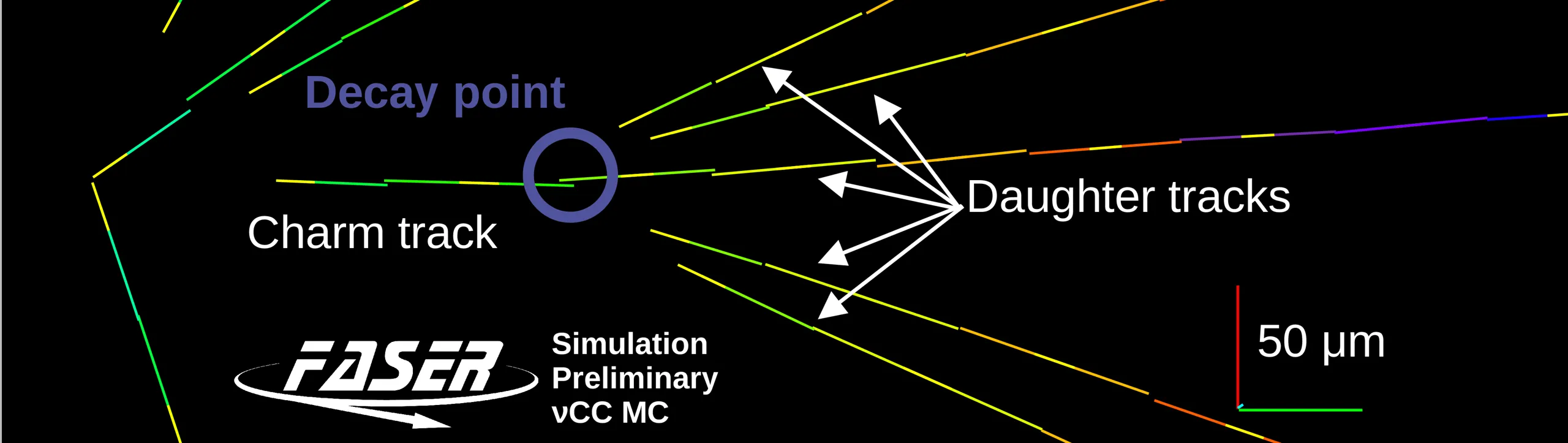
After such secondary vertices are reconstructed, a combination of cuts and a machine learning-based classification are used to separate potential charm decays from background interactions.
40 neutrino interaction candidates identified in the FASERν detector from a 2022 LHC run were analyzed, of which 33 were muon neutrino and 7 were electron neutrino candidates. To avoid biasing future analyses, a partial unblinding was performed by only passing a fourth of the neutrino candidates through the last machine learning-based step. Good agreement between the background estimates and observations was found. One candidate event showed promising signatures with a high probability of being a charm decay, though further analysis is needed to confirm whether it is a genuine charm decay or a background interaction.
This study is an important milestone for searches for charm hadrons created in neutrino interactions, and more generally, the beginning of detailed studies of the hadronic system of neutrino interactions in the TeV energy regime. The full unblinding, where all 40 neutrino candidates are analyzed, is expected in the near future. If charm particles are identified, it will mark the first observation of charm production in neutrino interactions in the TeV energy regime. With more data being collected and analysis techniques continuing to improve, FASER is opening entirely new windows into the physics of neutrinos and charm quarks at energies never explored before.
Learn More
- These results were announced at the 2026 Moriond Electroweak and QCD Conferences: see https://indico.in2p3.fr/event/39055/contributions/170310 and https://indico.cern.ch/event/1648766/contributions/6963969.
- For more details, see the conference note: https://cds.cern.ch/record/2956186/.
July 25, 2026