
New Dark Photon Results from the FASER Experiment
New Results from a Search for Dark Photons with the FASER Detector at the LHC
23 March 2026 | FASER Collaboration
FASER physicists are searching for hints of a “dark sector,” a class of new particles and forces that interact very weakly with ordinary matter. These dark sector particles may be produced in high-energy collisions at the LHC. In their latest result, scientists set new limits on one such particle, known as the dark photon, by looking for high-energy signatures in the FASER detector.
The identity of dark matter is one of the most important open questions in the field of physics. To tackle this question, physicists pay special attention to high-energy collisions at the Large Hadron Collider (LHC), because they can mimic early-universe conditions and therefore potentially produce dark matter particles.
FASER scientists are searching for hints of a hidden “dark sector,” a class of new particles and forces that interact very weakly with ordinary matter. An important hypothetical particle that may live in this hidden world is the “dark photon,” a particle much like our standard model photon. This dark photon could mix with normal photons, leading to many interesting signatures.
Since they interact so feebly, any dark photons or other such particles produced in the intense proton-proton collisions at the LHC could easily escape the LHC’s largest detectors unnoticed. They could then travel hundreds of meters along the collision line-of-sight before decaying into standard model particles, such as electron-positron pairs. Since these particles are boosted, and therefore are extremely energetic, they are easy to spot with a detector farther down the line-of-sight!
That’s exactly what the ForwArd Search ExpeRiment (FASER) is meant to do. It is situated in a separate tunnel 480 meters away from the ATLAS interaction point, and is pointed directly at this interaction point, so it is well positioned to catch these elusive long-lived particles. In this new result, the FASER collaboration has significantly expanded its search for dark photons, analyzing 177 fb-1 of data collected during LHC Run 3 between 2022 and 2024.
ASER’s first dark photon search in 2023 looked for a very specific signature, two high-momentum tracks created by the electrons and positrons produced by a dark photon decay. It was primarily sensitive to decays occurring in a 1.5m-long decay volume.
This time, to increase FASER’s sensitivity, FASER scientists found ways to modify their analysis to accept as many signal events as possible, while making sure not to let in any background processes. One aspect of this was removing the strict two track requirement. If a dark photon is highly boosted, its decay products can travel extremely close together, potentially tricking the detector into reconstructing them as a single merged track. FASER’s new analysis looks for at least one track with high energy, removing potential inefficiencies from this effect, and additionally accepts events that may have showered earlier in the detector and produced more than two tracks.
Additionally, there is close to 2.5 meters of space after the decay volume where a dark photon could decay before reaching the electromagnetic calorimeter. What if the dark photon lived slightly longer, and decayed here, in the downstream tracking spectrometer? To capture these events, researchers developed a novel “Segment Signal Region.” Instead of requiring fully reconstructed tracks, this new method hunts for isolated track segments—reconstructed clusters of charge deposited directly in the silicon strips of the later tracking stations.
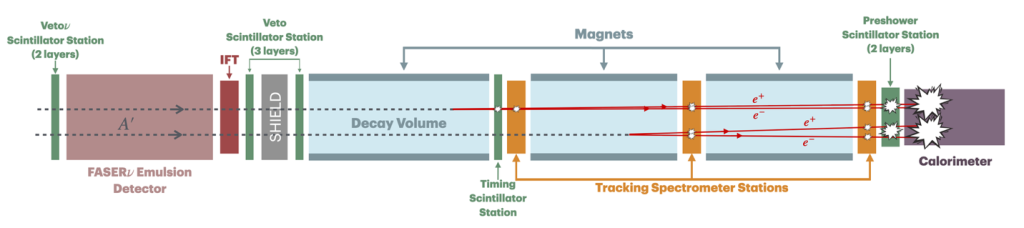
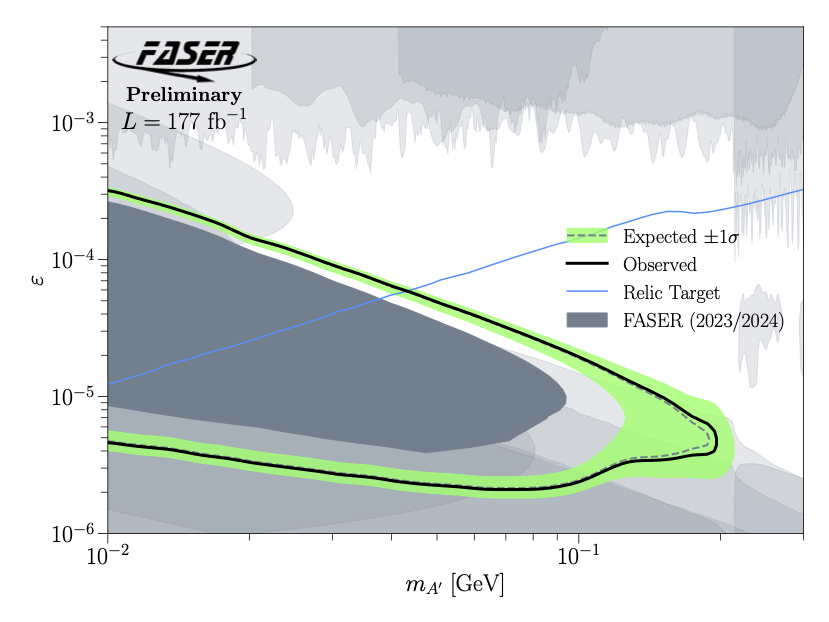
By combining these two approaches, FASER nearly tripled its sensitivity to dark photons. Additionally, thanks to the 100m of solid rock shielding the detector from other particles produced at the ATLAS interaction point and the high efficiency of FASER’s veto scintillators to filter out charged particles, the analysis is nearly background free. Any stray high-energy neutrinos or “geometric” muons scattering through the rock are removed from the analysis by clever tracking selections and high energy requirements.
After this analysis was conducted, zero events were observed. This means FASER sets world-leading constraints in dark photon parameter space. Specifically, FASER excluded parts of dark photon parameter space where the dark photons have a mass between 10 and 150 MeV and a coupling between 10-5 and 10-4. This rules out a significant area of cosmologically-viable parameter space, where dark sector particles could be responsible for the relic density of dark matter we see in the universe today.
FASER isn’t done yet either! With new upgrades and two more years of data to analyze, FASER will continue searching for this and other signals of new particles beyond the standard model.
Learn More
- These results were announced at the 60th Rencontres de Moriond – EW+U 2026 Conference: https://indico.in2p3.fr/event/39055/contributions/170310/.
- For more details, see the conference note: https://cds.cern.ch/record/2955719/.
July 24, 2026