
A New Way to See Electron Neutrinos at the LHC
Measurement of High-Energy Electron Neutrino Interactions with the FASER Calorimeter at the LHC
26 March 2026 | FASER Collaboration
Neutrinos are tiny, nearly massless particles that pass through matter almost undisturbed, making them extremely difficult to detect. Billions pass through your body every second, yet you could go an entire lifetime without even one interacting with you. FASER is one of only two detectors at the LHC capable of searching for these elusive particles, which typically pass through detectors without leaving any trace.
The FASER Collaboration has successfully detected one of these rarely-interacting particles, the electron neutrino, by detecting energy deposits in FASER, indicating a neutrino interaction. This was achieved using a sub-component called an electromagnetic calorimeter, which captures the energy of passing particles. Neutrinos traversing the FASER detector are typically expected to leave no signal, as if nothing has occurred. However, on very rare occasions, when they interact directly within the calorimeter, a large energy deposit is observed. In such cases, the events resemble the appearance of a large energy deposit in the calorimeter out of nowhere, while leaving no trace of something ever happening in any of the other subdetectors.
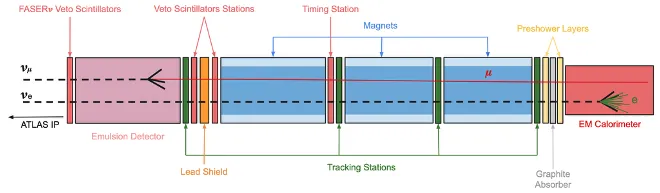
Using 176.8 fb⁻¹ of data collected during 2022, 2023, and 2024 as part of the LHC’s Run 3 at a collision energy of 13.6 TeV, a total of 105 such events were observed. The main challenge lies in distinguishing electron neutrinos from a similar particle, muon neutrinos. Although their expected signatures in the calorimeter differ, disentangling the two remains difficult. To address this, the analysis team leveraged FASER’s previous measurements of muon neutrino interaction rates using events containing the presence of a track, indicative of a muon neutrino interaction within FASER, to estimate the presence of muon neutrinos in the calorimeter. In the plot below we show the fitted electron neutrino component (in red) and our prediction for muon neutrinos (in blue).
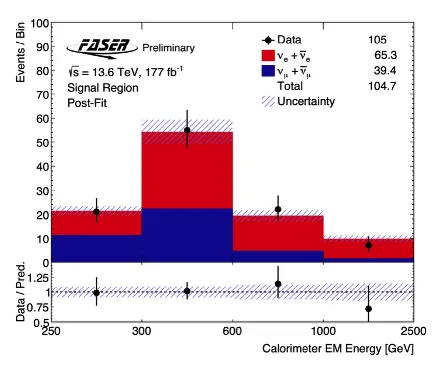
Out of the 105 observed events, 40 are attributed to muon neutrinos, while 65 are identified as electron neutrinos. The highest energy event was at 2.1 TeV, one of the most energetic electron-neutrinos ever measured at the LHC! These results are particularly exciting because they represent a second, independent method by which FASER has measured electron neutrinos at the highest man-made energies. FASER had previously seen electron neutrinos with its passive emulsion detector. The collaboration’s ingenuity was put to the test, as the calorimeter was not originally designed for this purpose. After noticing unusually large energy deposits during studies for a different analysis, we realized this could provide a new way to measure electron neutrinos.
This achievement opens a new window for studying neutrinos in a previously unexplored energy range. It enables the investigation of energy-dependent electron neutrino interactions and provides new opportunities to probe phenomena in astrophysics, particle production in collisions, and the Standard Model of particle physics.
Learn More
- For FASER’s previous muon neutrino results, see Phys. Rev. Lett. 134, 211801
- These results were announced at the 2026 Moriond Electroweak and QCD Conferences: see https://indico.in2p3.fr/event/39055/contributions/170310 and https://indico.cern.ch/event/1648766/contributions/6963969
- For more details, see the conference note: https://cds.cern.ch/record/2956447
July 25, 2026