
FASER physics
For decades, the leading examples of physics beyond the standard model (BSM) were heavy particles with TeV-scale masses and O(1) couplings to the standard model (SM). More recently, however, there is a growing and complementary interest in new particles that are much lighter and more weakly-coupled. Among their many motivations, such particles may yield dark matter with the correct thermal relic density and resolve outstanding discrepancies between theory and low-energy experiments. Perhaps most importantly, new particles that are light and weakly-coupled can be discovered by relatively inexpensive, small, and fast experiments with potentially revolutionary implications for particle physics and cosmology.
If new particles are light and very weakly coupled, the focus at the LHC on searches for new particles at high transverse momentum (pT) may be completely misguided. In contrast to TeV-scale particles, which are produced more or less isotropically, light particles with masses in the MeV-GeV range are dominantly produced at low pT. In addition, because the new particles are extremely weakly coupled, very large standard model event rates are required to discover the rare new physics events. These rates are not available at high pT, but they are available at low pT: at the 13 TeV LHC, the total inelastic pp scattering cross section is σinel(13 TeV) ≈ 75 mb, with most of it in the very forward direction. This implies
Ninel ≈ 2.3 ✕ 1016 (2.3 ✕ 1017)
inelastic pp scattering events for an integrated luminosity of 300 fb-1 at the LHC (3 ab-1 at the HL-LHC). Even extremely weakly-coupled new particles may therefore be produced in sufficient numbers in the very forward region. Due to their weak coupling to the SM, such particles are typically long-lived and travel a macroscopic distance before decaying back into SM particles. Moreover, such particles may be highly collimated. For example, new particles that are produced in pion or B-meson decays are typically produced within angles of θ ~ ΛQCD / E or mB / E of the beam collision axis, where E is the energy of the particle. For E ~ TeV, this implies that even ~500m downstream, such particles have only spread out ~ 10 cm – 1 m in the transverse plane. A small and inexpensive detector placed in the very forward region may therefore be capable of extremely sensitive searches, provided a suitable location can be found and the signal can be differentiated from the SM background
FASER is an experiment designed to take advantage of this opportunity. It is a small detector, with volume ~1 m3, that is placed along the beam collision axis in the very forward direction of the ATLAS IP.
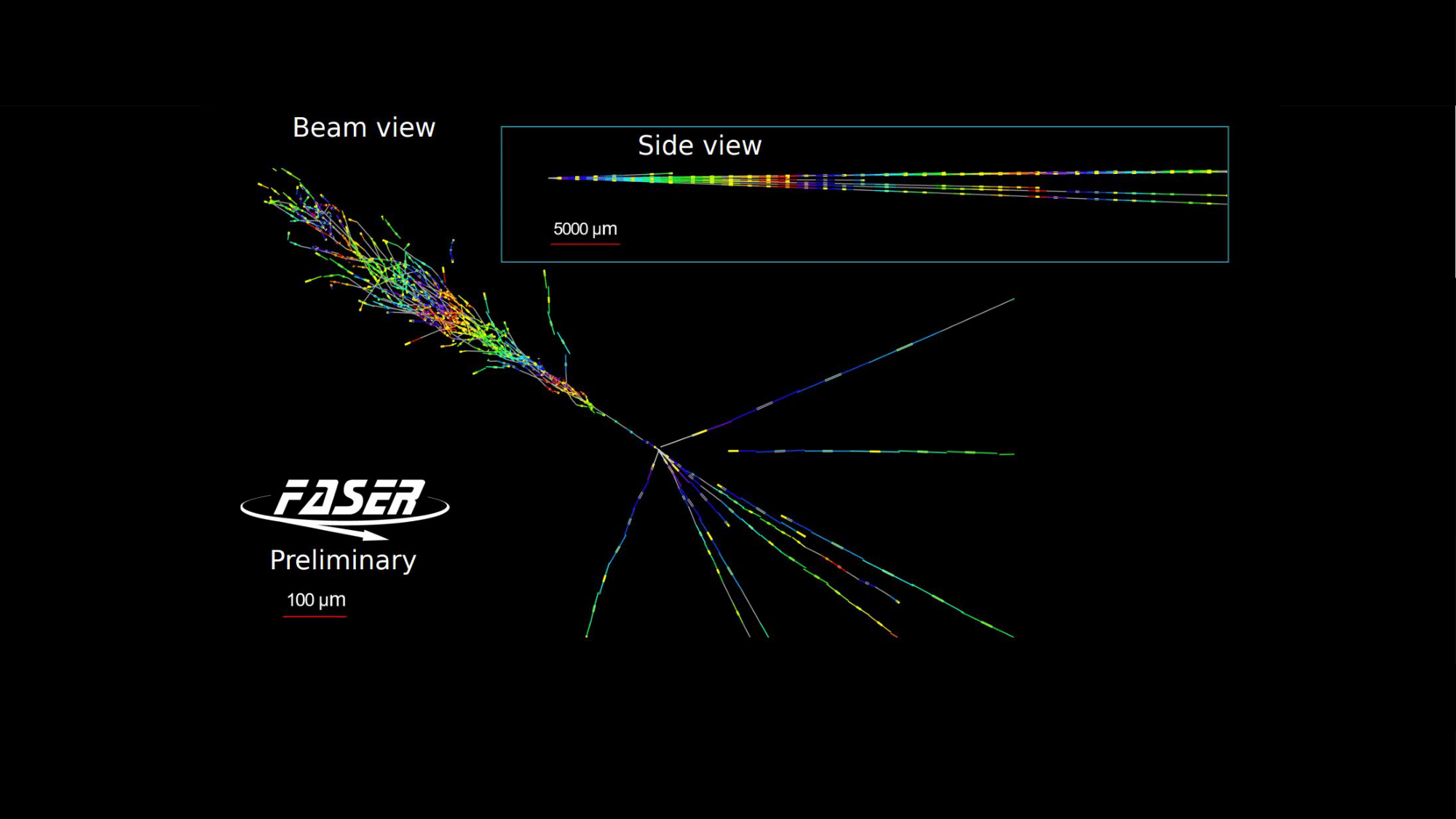
On top of extensive BSM programme, FASER is also looking to improve our understanding of the properties of the most weakly-interacting particles that have already been discovered, namely neutrinos. Neutrinos are copiously produced at particle colliders, but no collider neutrino has ever been detected. Colliders, and particularly hadron colliders, produce both neutrinos and anti-neutrinos of all flavors at very high energies, and they are therefore highly complementary to those from other sources. FASER, with its dedicated subdetector FASERν, will be able to detect and study thousands of neutrino interactions with mean energies of 600 GeV to 1 TeV. With such rates and energies, FASER will measure neutrino cross sections at energies where they are currently unconstrained, will bound models of forward particle production, and could open a new window on neutrino-related BSM physics.
Also On physics
-
Presentations about FASER
Presentations about FASER Invitations for conference talks by the FASER Collaboration should be sent to the Co-Spokepersons: Jonathan Feng (UC Irvine), jlf AT uci.edu Brian Petersen (CERN), Brian.Petersen AT cern.ch Meetings, Conferences and Workshops Seminars 2 January 2026